
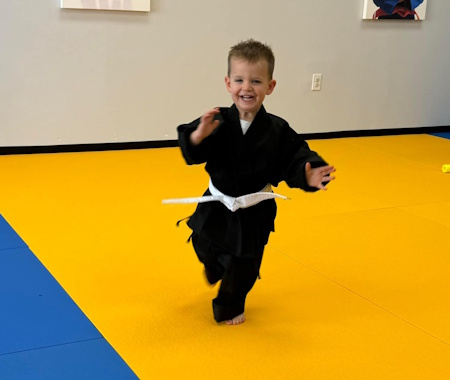
Preschool Karate Classes Knoxville TN,
Whether learning to be active is your goal, or building confidence through discipline, Karate and the broader Martial Arts is a go-to activity for young kids. But, how young? More and more parents are trying to encourage their little one’s development at an earlier age, even the toddler years. Are there preschool Karate classes in Knoxville? And, should you even try them?
YES, there preschool aged Karate classes right here in Knoxville, that helps build crucial development skills. The key is finding the right class focused on the preschool format, meaning: smaller classes, learning through play, and a fun safe environment. Karate can be a great tool for young learners, as long as it is designed for their needs.
Interested in Karate? Check out our location here!
How do you know if Karate Dojo is right for your little one? Are preschool classes just: “baby adult classes”? What age can a preschooler really start their Karate journey? Is a two year old too young? Let’s find out the answer to those questions and more!
What Is A Good Preschool Karate Class?
Parents want the best for their children, no question. Many want them to get a head start on their early milestones, whether it’s: reading, potty training, or motor skills. Karate has a lot of those early coordination skills built in, and has the added benefit of discipline (which I will talk about later). If we’re trying to introduce them to Karate, what would a good class look like?
A good Karate class for kids should be: fun, safe, and designed for kids specifically (not just “diet” adult class). The Martial Arts is a long road, and it shouldn’t be a race to the end. Instead, you want kids to enjoy it and engage with it above all else, which leads to it being a life long journey.
It helped my life, it can definitely help your little one too.
This research below compiled many studies on the benefits of improving motor function through “interventions” for preschool aged children (i.e. planned physical activities). It found the most benefits came from a teacher led activity.
Van Capelle, A., Broderick, C. R., van Doorn, N., Ward, R. E., & Parmenter, B. J. (2017). Interventions to improve fundamental motor skills in pre-school aged children: A systematic review and meta-analysis. Journal of Science and Medicine in Sport, 20(7), 658–666. https://doi.org/10.1016/j.jsams.2016.11.008
Karate can definitely fit that description, as long as the instructor knows to engage with the kids the right way.
How can we know if class is really designed for kids, especially those at the preschool age? What should we look for? Let’s dive deeper!
Fun
More than anything else, Karate has to be fun for preschoolers. You don't want a focus on overly technical movement and strikes, or the dreaded “boring” Katas. You want something at their level, that is game oriented.
If a preschooler doesn’t enjoy it, they won't keep doing it. In preschool environments, little ones learn not through study, but play. A good Karate should be fun and exciting. An instructor who can talk at their level, through a silly and playful manner, is paramount for preschoolers to truly engage with the Martial Arts.
Play is the name of the game when it comes to Preschoolers. When kids get older they can start learning and practicing “delayed gratification”.
Delayed Gratification from Cambridge:
pleasure or satisfaction that cannot be experienced immediately, but that you must wait for or work for
That is a concept that preschoolers struggle with and aren’t necessarily ready for. It’s hard for them to sacrifice the enjoyment now, for the joy of progress later. That’s why fun has to be upfront and center.
If fun is truly crucial, how can Karate be fun?
Games:
You boil down all of the Karate staples like: punches, kicks, body movement, wrestling, and hand-eye coordination to simple and predictable games.
For example, learning to kick in the air doesn’t excite kids. But, learning kicks by knocking an instructor down (holding a pad, of course), turn a simple drill into hilarious laughter from a preschooler.
Silly:
This leads to my next point nicely: silly shenanigans. The way to make anything a game, and the key to a child's heart, is to talk in a playful manner. Saying something that is not true in an overly exaggerated way, works wonders.
The instructor is what makes Karate for preschoolers possible. If they have a bored or reserved demeanor, 2-4s aren’t going to respond well with it. You need someone who puts lots of energy in how they talk and teach the class.
Energy + Silly = Fun Karate
The sky is green, stinky toes, and “what’s your favorite bug to kiss?” are my personal favorites.
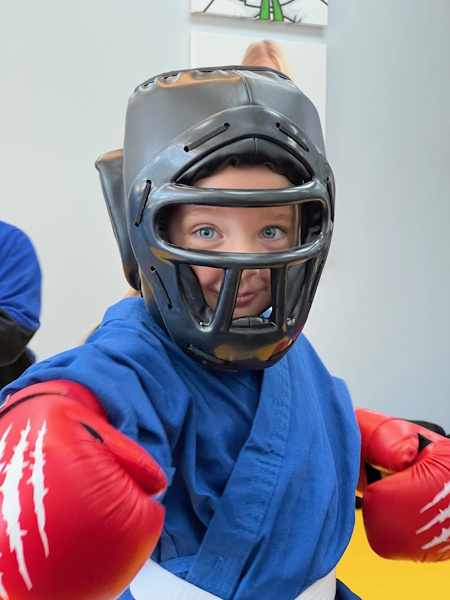
Safe
Fun and silly goes side by side with safety. Let me explain:
For young kids to be safe, and feel safe, the Karate Instructor needs to talk in a fun and welcoming manner, while teaching things appropriate for their age. For kids to trust their Sensei, the teacher needs to be gentle and goofy (to make them less imposing).
Likewise, what they teach should always be predicated that Karate is never meant to harm anyone, only make us better.
A great instructor should always sound different when talking to a kid, vs talking to an adult. What do I mean?
They need to talk on their level, and in a way that engages with them, whereas an instructor interacting with parents can let down the “performance”. Predictably matters to kids, more so for preschool aged. Regardless of the teacher's mood or readiness, they need to be the cheerful guy/gal they've always been.
Performance = Professional
For Kids
With regards to the curriculum, certain things are inappropriate to teach such small children. Certain techniques are too advanced, and might lead them to hurt themselves in the process. Or they can be too adult oriented like: chokes, armbars and the like.
A preschool Karate class should never be an Adult class with some of the “hardcore” elements removed. It needs to be something designed around the child, nurturing character building and improving motor skills.
At Master Booe’s Karate Kidz, we never teach armbar or chokes. This is problematic not just for preschoolers, but any child or teenager. That is something strictly for adults, due to how dangerous those moves can be.
Armbars, for those unfamiliar, are how to break someone's arm. If your Dojo is teaching any child how to practice these techniques, we would strongly recommend finding a more appropriate location.
BONUS: DISCIPLINE
Another component of a good Karate class is having a gentle but strict class structure. Some of the main goals for having a preschooler do Karate is to learn to be in a class, how to respond to instructions, and how to interact with other kids their age.
Discipline isn’t an excuse to badger a kid, but to encourage them to be a better friend to their classmates.
Karate class can help kids learn to share, help, and practice with new friends. It takes a while for kids to adjust and learn, and sometimes that needs to be met with clear rules. Not out of anger, but a desire to see the child learn to be in a group.
Is Karate Good For My 4 year old?
Karate is great for kids of all ages, sure. It can help with learning a class-like structure, social interaction, hand-eye coordination, and other physical milestones. But, what about my child? It is a good fit for them. First, let's start with the question: Is Karate Good For My 4 year old?
Karate at 4 years old is nearly a perfect age to start their Martial Arts journey. At this age they’re beginning to develop better social skills and starting to be more comfortable in a class environment. Which allows Karate to help improve movement control and meet their physical based milestones.
A 4 year old doesn’t need to be an expert, or even passable at Martial Arts. That’s what classes are for, to get them further than they started. What they need is to be able to follow along in a class, then the rest will come.
Learn by doing.
To learn the techniques and control over one’s body comes with practice. The best practice is to try (and fail) again and again. In a safe and encouraging environment this will allow any 4 year old to thrive.
If you’re still not convinced about 4 year olds practicing Karate, I’ve linked this research down below. It focused on a multitude of ages, with those as young as 4 years old, and how the Martial Arts broadly helped fitness, coordination, balance. This was across many studies on the matter.
Stamenković, A., Manić, M., Roklicer, R., Trivić, T., Malović, P., & Drid, P. (2022). Effects of Participating in Martial Arts in Children: A Systematic Review. Children, 9(8), 1203. https://doi.org/10.3390/children9081203.
Karate can definitely help a 4 year old. What’s important is making sure the program is tailored to their needs and not just an afterthought, or an add-on to an adult focused Dojo.
(If interested, I have an article on this topic alone here)
Is Karate Good For My 3 year old?
Karate for 4 year olds is not only doable but has been proven to help. But, what about the younger preschool ages? Is karate good for a 3 year old?
Yes, Karate can be good for a 3 year old albeit in the right environments. The instructor’s engagement in the class, along with the room itself, matters more than the style of Martial Arts. If the lessons are taught in a fun, encouraging, and safe manner then many young three year olds could benefit from Karate.
There are some important things to note when it comes to young 3s. Firstly, it can be a shock for a little one to be brought to a new environment. Sometimes the building itself is the first major obstacle.
I like to use the example of: going into a new building is like landing on a new planet for a preschooler. And Mars can be scary for the first time. It might take a minute (or many more) for a 3 year old to acclimate.
After that a good instructor would need to make them feel comfortable, which I would encourage through the use of jokes and a silly attitude.
Patience is key for helping any little one in a new activity. Coming first from the instructors and Sensei, but parents will have to show some patience too. Some parents might expect their child to immediately warm up to Karate, and that's not always the case. It might take a class or two for their child to fully participate in lessons. And that's okay!
To encourage a 3 year old to continue Karate could provide real benefits. This research gathered many studies, and found kids as young 3 practicing any kind of physical program helped them meet their motor function milestones. Things like jumping, balance, running, and other motor skills can be benefited by these activities.
Xin, F., Chen, S.-T., Clark, C., Hong, J.-T., Liu, Y., & Cai, Y.-J. (2020). Relationship between fundamental movement skills and physical activity in preschool-aged children: A systematic review. International Journal of Environmental Research and Public Health, 17(10), 3566. https://doi.org/10.3390/ijerph17103566
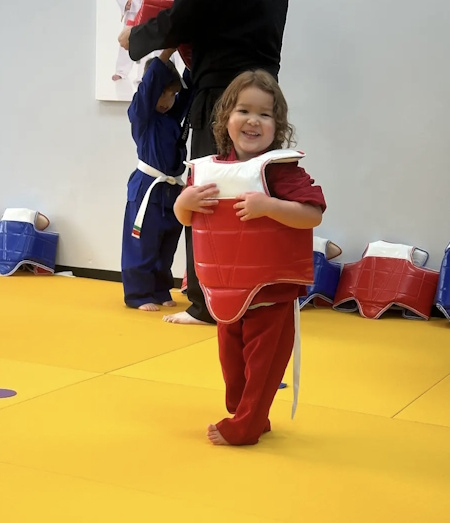
Is Karate Good For My 2 year old
Now, to the elephant in the room. Or better yet, the tiny little (sometimes grumpy) elephant in the room. Is Karate good for a 2 year old? Can they even do a class?
Yes and no. Karate can be a good thing for a tiny two, but only if the instructor and Dojo is designed for their particular needs. A Dojo made just for kids, and specialized for the younger ages would have the best results. But, it really is dependent on the individual 2 year old, if they’re ready or not.
We already talked about the potential benefits of a Karate journey for 4s and 3s. Those benefits can trickle down to a 2 year old. Things running, jumping, crawls, and hand-eye coordination are some of the major positives. The question isn’t really whether Karate is good, it’s whether they can do Karate.
Truthy, not all 2 year olds can do a full Karate class. That's perfectly fine. Some are able to follow the class structure faster, whereas others need to wait just a little longer. There's nothing wrong if your child needs to wait. Though that doesn’t mean it can't be helpful for those who can.
For the best results, you need:
A personal instructor
Your child gets to know one or two Sensei’s, not a revolving door of new teachers every week. This helps them build trust and a sense of predictability.
A small environment
The room needs to be made for them in mind, the bigger it is the smaller they feel. Likewise, the number of students in a class should reflect that. Smaller = Better
A kid focused program
Starting with the basics and making it easy to understand. Fun upfront and center with simple games and drills to help them be active.
(P.S. I have another article on this exact topic here)
What age is the best for a child to start Karate?
Karate can be good for kids, check! Preschoolers can do Karate, and we discussed why they should if they are able to. Next comes the question: what is the best age to start?
It’s best to start as young as possible for Karate. Almost all 4 year olds take to Karate immediately, though younger ages can do it too. Karate and the broader Martial Arts is a life long journey, that's best started young. It's not only about becoming better physically, it’s becoming a better person through character.
You can start at any age to become better fit and active. The thing that Karate has that many other activities and sports lack, is character building. Through learning discipline, responsibly, and learning to practice and take care of partners. That’s why Karate is best started young, because it helps you become a better person.
For further evidence of Karate not just being a fun physical activity, I have linked this article below. It studied two groups: karate kids and then sedentary kids. With an average age of around 9 years old, they are definitely not preschoolers anymore (but still young). It found that those taking Martial Arts classes performed better in physical activities than those who didn’t.
The interesting piece from the study was that the "karate kids” also performed better in cognitive tests. Memory retention, listening skills, and problem solving was seemingly helped by taking Karate.
Alesi, M., Bianco, A., Padulo, J., Vella, F. P., Petrucci, M., Paoli, A., Palma, A., & Pepi, A. (2014). Motor and cognitive development: The role of karate. Muscles, Ligaments and Tendons Journal, 4(2), 114–120. https://pubmed.ncbi.nlm.nih.gov/25332920/
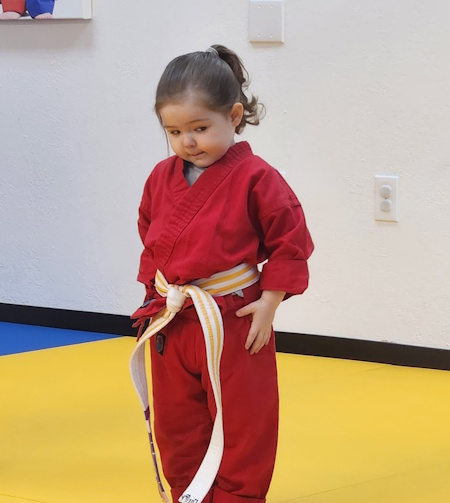
Is Karate Appropriate for My Preschooler?
We discussed how Karate can be good for preschoolers, and what you really should look for in a good kids program. One question that goes past that though, suggesting something unsavory with the Martial Arts, is Karate even appropriate for preschoolers?
Yes, Karate is absolutely appropriate for preschoolers. Taught in a fun and energizing way, kids are learning control over their bodies. Taking care of ourselves, and friends, is a cornerstone of Karate.
The only caveat I would offer is that some Dojos are just gyms in disguise. Few preschoolers would be comfortable in a large gym-like room with adult’s training in the background. That does happen, and that would be inappropriate.
Preschoolers should have their own place to learn, and shouldn’t have to share with grown men training “hard” on the mat.
What Martial Arts is best for my 3 year old, or any preschooler?
This is a natural question since there are so many different styles and variations in the Martial Arts. Not all are best taught to children, because they focus on too many adult techniques. So, what is the best style of Martial Arts for my preschooler?
Karate, Taekwondo, and Judo are some of the best Martial Arts for a 3 year old, or even preschoolers in general. These styles have a rich pool of techniques to pull from, and commonly have large kid focused programs and Dojos.
One thing that helps kids learn, especially younger ages, is variety. Keeping things fresh and exciting is essential to maintaining the fun of a class. When a child starts to think they know what to expect in every class, they’re about to say the dreaded line for any teacher: “I’m bored”.
These styles are great for kids due to the sheer amount of things they can teach. However, the best Dojo’s and instructors should know to pull from all of the Martial Arts, not just one. Grabbing the good from all these styles, and maybe ignoring some the bad parts (and sometimes hokey), is what makes a well rounded curriculum.